Torn or Sagging Fly Screens: Repair or Replace?
The Direct Answer
Torn or sagging fly screen mesh is worth replacing on its own when the frame still sits square, the edges can hold fresh mesh and any moving parts work properly. Patching is often enough for an isolated hole with firm strands around it. A frame that stays bowed, a damaged groove that cannot grip the mesh or a retracting mechanism with no serviceable parts can make replacement of the screen assembly the better repair.
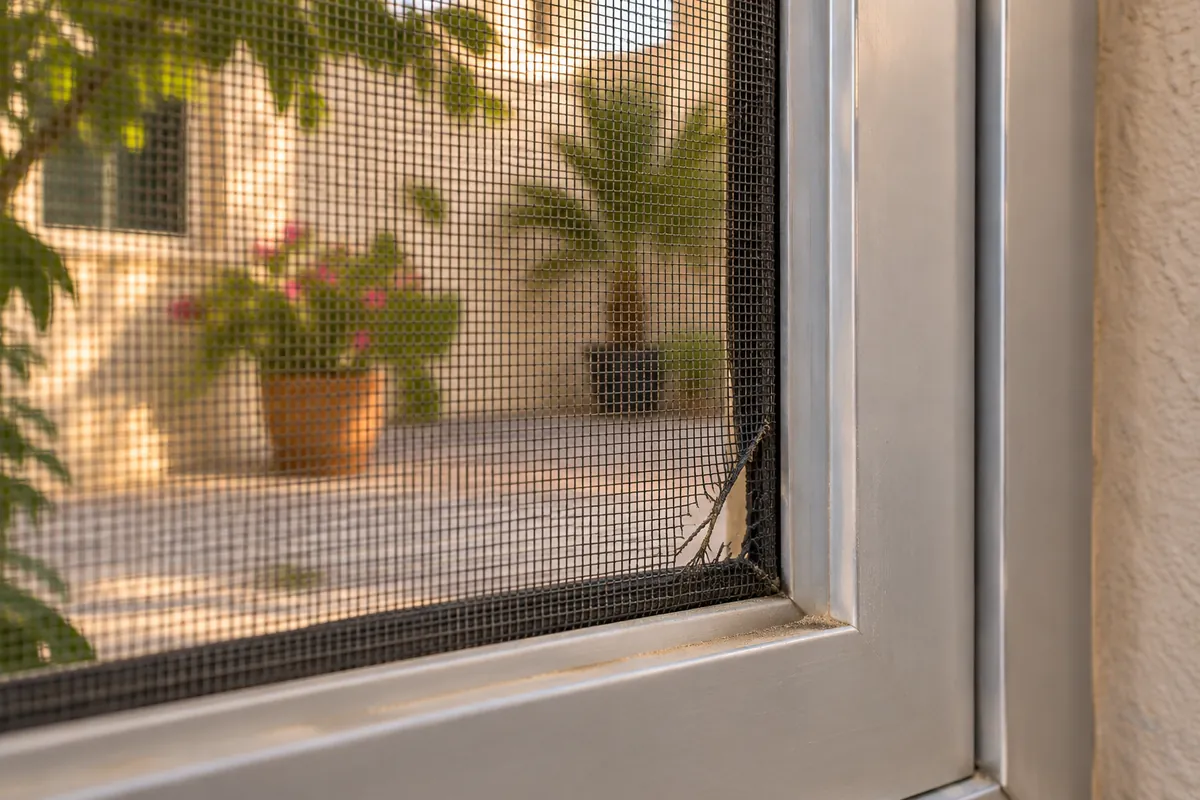
The tear is usually the easiest thing to see. A better clue is what happens around it. A clean slit where something caught the screen is a different job from a split that has opened along a worn bottom edge. And a strip of daylight at the side of a closed screen may look like a hole from across the room even when every strand is intact. Before the mesh comes off, it pays to find out which part stopped doing its job.
Is the mesh damaged, or has it pulled away from the frame?
With the screen closed and daylight behind it, the first place to look is the perimeter. A puncture interrupts the weave. A gap between the panel and the opening leaves the weave intact and runs along the outside of the frame. A gap just inside the frame can be a loose edge: on a conventional flat panel, a flexible cord called a spline presses the mesh into a groove. If a length of cord is visibly raised or missing, the cloth can droop even though the middle is undamaged.
The movement of a sliding or retracting screen offers another clue. If the panel catches at the same spot during gentle travel, the track or a moving part deserves a look before the mesh is blamed. If it travels freely but the cloth hangs slack when closed, the next check is where the mesh is held. A creased pleated screen can look uneven while it is partly open; the useful signs are a split along a fold, an edge that escapes its guide, or a gap that remains at full closure.
A screen should be checked from a safe position indoors, without leaning on it or reaching outside to free a stuck panel. The US Consumer Product Safety Commission specifically advises against relying on window screens to keep children from falling. A well-fitted insect screen is still only an insect screen.
- Through the weave: look for broken or missing strands.
- Between the weave and the frame: inspect the mesh fastening or guide.
- Between the panel and the opening: inspect the fit, corners and closing edge.
- At the same point in every pass: check the track before blaming the cloth.
What does Gulf weather do to a fly screen?
The Dubai Government Media Office puts the city's average summer high at about 41.8 °C and describes most days as sunny throughout the year. That puts exposed screens in a sustained stretch of heat and bright sun, but it does not give them a common expiry date. A sheltered panel and a panel in direct afternoon sun can look quite different by the time either needs attention. The better comparison is between the exposed part of the same screen and a section that spends more time in shade, looking for broken strands or flaking rather than a difference in shade alone.
The coating and the strands are worth distinguishing. Phifer, for example, makes fibreglass screen mesh with a protective vinyl coating. Research from the US National Institute of Standards and Technology describes how outdoor weathering can degrade and crack vinyl siding. Siding is a different product, so that research cannot say how long a screen coating will last. At the window, more persuasive evidence is a coating that flakes in several places or strands that break during ordinary handling. A dusty surface can look faded without having lost its strength.
Wind can damage screening outright, as Phifer notes in its replacement guide. Grit also collects where screens have to move. A gritty scrape during travel is a reason to inspect the guide for debris rather than pull harder on the handle. A deposit that brushes away is a cleaning job; a guide that is visibly crooked or damaged still needs attention afterwards.
Near the coast, there is a separate reason to look at the metal. The Canadian Conservation Institute explains that chlorides can stop aluminium's natural protective layer from re-forming after damage, leaving pits in the surface. That makes a chipped area in a salt-exposed groove worth a closer look. Surface marks away from the mesh may have little bearing on the decision. Roughness where the fabric seats or passes through a guide matters, because the new mesh will have to sit against or travel past that same spot.
When is a small patch enough?
An isolated puncture is a reasonable candidate if the weave around it is intact and there is enough sound mesh for a compatible patch to grip. Phifer's guidance describes patching a small damaged area rather than replacing the whole panel. On a flat screen the repair can be a sensible way to keep a usable panel in service, especially if the patch will sit off to one side. The important part is the condition of the material around the hole, since that is what holds the patch.
A tear running into the groove leaves little sound material at the edge to work with. The same applies to a cluster of pinholes with frayed strands in between: covering the most visible hole leaves the rest of the failing area in place. A patch is also a poor default on a fold or on material that has to roll into a cassette. Unless the maker specifies a patch for that system, the extra layer could catch where the cloth needs to pass freely.
When does re-meshing make sense?
Re-meshing keeps the existing frame and replaces the fabric across the whole panel. It is a good fit for a long tear or several worn areas when the frame sits properly and the mesh can be secured along the entire perimeter. Where a flat panel has just one loose edge and the fabric is still sound, it may only need a new or properly seated spline. That is worth checking before discarding material that still has enough intact edge to seat in the groove. If the strands have torn away right at the fastening or the fabric no longer reaches it without pulling, fresh mesh is the more useful repair.
On an ordinary removable flat panel, the materials have to work together. Phifer's spline guide shows why: the cord is sized to the groove and the mesh, and thicker fabric can need a different cord in the same frame. The old spline is a useful reference if the mesh is staying the same. After fitting, the cloth should sit evenly, the cord should stay down at the corners, and the frame should go back into the opening without being forced. A smoother surface is of little use if the frame comes back with a gap at one end.
- Set the removable panel on a flat work surface and lift out the old spline and mesh.
- Check the empty groove and choose a spline compatible with both the groove and the new fabric.
- Lay the new mesh square with spare material beyond the groove; hold it straight as the spline is rolled in.
- Seat the corners, trim on the outside of the groove and check the panel for gaps after refitting.
Retractable mesh needs a model-specific assessment because the fabric must travel as well as cover the opening. That can mean identifying the original assembly before deciding whether the cloth can be changed separately. In Dubai, Dream Fly Screen lists replacement of torn or sagging mesh on their website. Whether a mesh-only job makes sense depends on the condition of the screen already in place.
When has the frame or mechanism had it?
A dent in the visible face of an aluminium frame can be cosmetic. A bowed side that leaves a gap at closure, a separated corner that will not hold, or a crushed section of groove is different. Fresh fabric cannot restore the frame's shape or give a damaged groove its grip back. If the bad corner or rail can be replaced and the panel made square again, there may still be a repair. Where the frame is damaged in several places, the work can amount to rebuilding most of the panel.
A screen that will not retract fully or keeps slipping out of its guide with the track clear needs a closer look at the mechanism. If a compatible guide or other part is available, replacing that component may be enough. If the part is unavailable and the screen cannot reliably close or retract, a mesh-only job leaves the original fault in place. The useful question for a repairer is which part would be retained and how the screen would be checked after the work. Replacing a separate screen assembly need not mean replacing the window or glazed door it serves.
| Finding | What is still sound | Repair to consider |
|---|---|---|
| Small puncture away from the edge | Surrounding weave and frame | Compatible patch on a flat panel |
| Local slack at a lifted spline | Mesh with enough sound edge and an undamaged groove | Reseat or replace the spline |
| Long split or widespread fraying | Square frame and secure fastening points | Re-mesh the panel |
| Intact mesh on a screen that binds | The fabric may still be usable | Clear debris and check for a serviceable track or guide fault |
| Persistent gap from an unrepairable bowed frame | The opening may still be sound | Replace the screen assembly |
What care helps a screen last after the repair?
The routine can start with the dirt that is easiest to remove. For its retractable patio-door screens, Andersen recommends a soft-bristle brush for loose dust on the mesh and a vacuum or soft cloth for debris in the tracks. Its guidance also cautions against oil-based lubricants and cleaners because they can attract more debris. That advice is for an Andersen system; the care sheet for the installed screen should decide what can go on its tracks or fabric. Phifer, for instance, distinguishes between water-only rinsing for its metal screening and mild soapy cleaning without hard scrubbing for its vinyl screening.
Andersen suggests checking its retractable model at least annually in ordinary conditions and at least every three months where coastal or other airborne material is heavy. Those intervals belong to that product. At a Gulf home, visible grit after dusty weather is a practical reason to look sooner. A screen that still meets resistance after loose debris is removed needs inspection rather than harder pulling. The same goes for new mesh that starts fraying at the same corner as the old fabric: the next job is finding where it rubs, before another panel goes in.
- Lift loose grit from reachable guides with the tool recommended for the screen.
- Clean the mesh only with a method suitable for its material.
- Close the screen gently and see whether the edge still seats all the way along.
- Stop if it binds after cleaning; note where it catches before arranging repair.
Frequently Asked Questions
How is torn fly screen mesh replaced?
On a removable flat panel with a spline, the old cord and mesh come out, then compatible new mesh is pressed into the groove with a correctly sized spline. The finished panel should sit square and close without gaps. Pleated and roll-up units need the method specified for their own assembly.
Can sagging mesh be tightened without replacing it?
Sometimes, if a short section has slipped and there is enough sound fabric to fasten it again. Slack that comes with broken strands across the panel or a damaged fastening channel needs more than tightening. On a retractable model, the installer or maker should identify how the mesh is held before anyone adjusts the tension.
Does faded mesh need to be replaced?
Fading alone does not show whether the mesh has failed. Cleaning by an approved method can help distinguish surface dust from a change in the material. Splits in several places, flaking or strands breaking under ordinary handling make a stronger case for changing it.
What if a new screen tears in the same place as the old one?
The repeated location is a reason to check for contact with the frame, track or closing edge during normal travel. A close photo of the tear and a wider photo of the closed screen can help show whether it lines up with a particular corner or fitting. Repairing the contact point matters before fitting another sheet of mesh.
Can the screen be re-meshed if its frame is scratched?
A surface scratch need not rule out re-meshing if the frame still fits and the groove is intact. A sharp edge where the mesh sits, a loose corner or a gap at closure is a different matter and should be dealt with before new fabric goes in.
Should all the screens be re-meshed when one wears out?
Only screens with defects need the work. Panels around the same home can have different exposure or see different amounts of use. Checking the edges on the other panels is more useful than ordering new mesh for the whole property based on the condition of one.
Sources
- Dubai Government Media Office — Geographic Location & Climate
- US Consumer Product Safety Commission — CPSC Urges Families to Protect Children During National Window Safety Week
- National Institute of Standards and Technology — Effects of Weathering and Formulation on the Properties of Vinyl Siding
- Phifer — Fiberglass Window & Door Screens
- Phifer — Door & Window Screening Replacement Guide
- Phifer — How to Choose the Right Screen Spline Size
- Phifer — How to Replace a Window, Door or Patio Screen
- Phifer — Frequently Asked Questions
- Andersen — Clean and Maintain Andersen® Retractable Screens on Gliding Patio Doors
- Canadian Conservation Institute — Storage of Metals